

Scope: This article discusses how the M² factor affects CO2 laser processing performance, with a particular focus on RF CO2 lasers used in precision cutting, marking, and micro-hole processing. The calculation examples use a wavelength of 10.6 μm. The same formulas can also be applied to other CO2 laser wavelengths, such as 9.3 μm and 10.2 μm, by replacing λ with the corresponding wavelength in actual calculations.
When selecting a CO2 laser, output power is important, but it does not fully predict processing quality. Power describes the output energy level, while the M² factor indicates how effectively that energy can be focused into a small and concentrated focal area.
Under fixed optical conditions, a lower and more symmetric M² factor usually helps achieve a smaller focused spot, higher equivalent average power density, and more stable performance in precision processing. It can further influence kerf width, heat-affected zone, micro-hole roundness, and marking line quality.
However, M² alone does not determine the final processing result. Laser selection should also consider power stability, beam mode, optical alignment, laser focus lens quality, modulation response, and process parameters. For equipment manufacturers and end users, the more meaningful reference is whether the laser can maintain long-term consistency on real substrates, at real processing speeds, and under continuous production conditions.
Why Do CO2 Lasers with the Same Power Deliver Different Processing Results?
When customers choose a CO2 laser, the first specification they often ask about is output wattage. Power is certainly important. If the actual output power is insufficient, cutting speed, processable material thickness, and production efficiency will all be limited.
However, in precision cutting, micro-hole processing, and high-resolution marking, power rating alone does not explain all performance differences. Two CO2 lasers with the same rated 50 W output can still produce noticeably different cutting, drilling, or marking results. One may cut fine and clean edges, while the other may cause edge melting, yellow scorching, non-round holes, or blurred small characters.
The reason is that even when the rated output power is similar, the spot dimensions, energy distribution, beam symmetry, and output stability at the substrate surface may differ significantly. These differences usually result from the combined effects of beam quality, optical path condition, focusing system, and process parameters.
1. What Is M²?
M², also known as the beam quality factor, is used to describe how much a real laser beam deviates from an ideal diffraction-limited Gaussian beam. It can be understood as the ratio between the Beam Parameter Product (BPP) of the actual beam and that of an ideal Gaussian beam.
Basic definition:
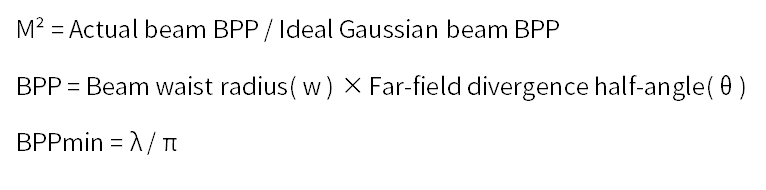
BPP is usually expressed in mm·mrad. An ideal TEM₀₀ fundamental Gaussian beam under diffraction-limited conditions has M² = 1.0. Real laser beams typically have M² greater than 1.
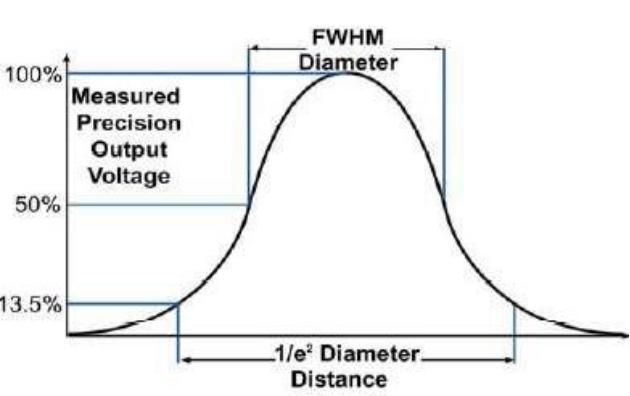
Ideal Gaussian beam profile
In general, the closer M² is to 1, the closer the beam is to an ideal Gaussian beam, and the easier it is to focus the beam into a smaller spot with more concentrated energy. M² is typically measured according to ISO 11146: the beam radius is measured at multiple positions along the optical axis, and the beam waist and divergence angle are fitted to obtain the beam propagation factor.
It is important to note that although M² is often presented as a single number, a real beam may have different propagation characteristics in the X and Y directions. For some RF slab structures, M²ₓ and M²ᵧ may not be equal. This axis asymmetry can affect micro-hole circularity, kerf uniformity, and marking line stability.
2. How Does M² Affect the Focused Spot?
The effect of M² on processing performance first appears in the focused spot. Under fixed optical conditions, the focused spot diameter is approximately proportional to M²:
Approximate formula for focused spot diameter:
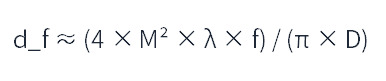
Where d_f is the focused spot diameter, λ is the laser wavelength, f is the focal length of the laser focus lens, and D is the effective beam diameter incident on the laser focus lens.
In this approximation, D should be understood based on the same beam-width definition, typically the effective 1/e² beam diameter, rather than the physical clear aperture of the laser focus lens.
This approximation shows that when wavelength, focal length, and incident beam diameter remain unchanged, a higher M² theoretically leads to a larger focused spot. The closer M² is to 1, the easier it is to focus the beam into a smaller and more concentrated area.
This is why M² is an important specification in precision cutting, micro-hole processing, and small-character marking. A smaller spot makes it easier to concentrate energy on the substrate surface, which helps control kerf width, heat-affected zone, hole roundness, and marking line quality.
The focused spot diameter is proportional to the wavelength λ. Common CO2 lasers operate at 10.6 μm, which is much longer than the approximately 1 μm wavelength of fiber lasers. Therefore, under the same optical conditions, the theoretical focused spot of a CO2 laser is inherently larger. When an application requires a narrower kerf, smaller hole diameter, or sharper marking lines, the influence of M², optical alignment, and laser focus lens quality becomes more noticeable.
For example, using a 10.6 μm CO2 laser with a laser focus lens focal length of f = 63.5 mm and an effective 1/e² beam diameter of D = 8 mm at the laser focus lens:
· When M² = 1.1, the focused spot diameter is approximately 118 μm.
· When M² = 1.5, the focused spot diameter is approximately 161 μm.
Under the same optical setup, increasing M² from 1.1 to 1.5 significantly enlarges the focused spot. For general engraving, this difference may not be very obvious. However, in film cutting, micro-hole arrays, small-character marking, and QR code marking, it may directly affect edge quality, hole roundness, and line clarity.
This approximation serves only to demonstrate general performance trends. It assumes that the incident beam is well collimated and that D is the effective beam diameter incident on the laser focus lens. Lens aberration, lens contamination, thermal lensing, and alignment errors are not included. In a real system, the result should be evaluated together with the specific optical configuration.
3. Why Does M² Affect Power Density?
If the equivalent average power density is estimated based on spot area, power density is inversely proportional to the square of the spot diameter. Therefore, at the same actual output power, a larger spot means lower equivalent average power density per unit area.
Equivalent average power density:
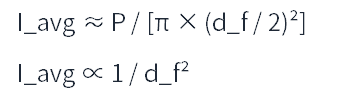
Here, I_avg refers to the average power density estimated from the spot area. It is not the same as the peak power density at the center of a Gaussian beam.
Because d_f is approximately proportional to M², the equivalent average power density will decrease approximately with the square of M² when the actual output power remains unchanged and the optical conditions are comparable.
Continuing with the previous example, when M² increases from 1.1 to 1.5, the spot diameter increases by about 1.37 times, and the spot area increases by about 1.86 times. As a result, the equivalent average power density at the focus drops to about 54%. This point is easily overlooked when only rated power is compared.
In actual processing, this may appear as reduced cutting speed, a wider heat-affected zone, or loss of detail in micro-hole processing and fine marking. The severity of these effects is further governed by material processing threshold, optical absorption, thermal diffusion, assist gas parameters, and the selected processing strategy.
The Trade-Off Between Depth of Focus and Spot Size
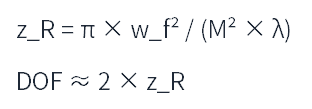
Depth of focus is often misunderstood. For the same target focused spot radius w_f, the Rayleigh length can be approximated as:
Rayleigh length and depth of focus:
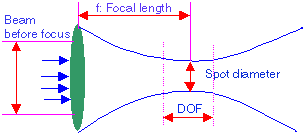
Position of depth of focus
For the same target spot size, a lower M² generally helps achieve a longer depth of focus.
A common misunderstanding is that a beam with a higher M² has a longer depth of focus. This may only appear to be true under the same optical setup. In that case, the longer depth of focus usually comes with a larger spot size, meaning that focusing precision has been sacrificed.
A more meaningful comparison is to evaluate depth of focus at the same target spot size. In most cases, a lower M² helps achieve a better balance between a small spot and sufficient focal-position tolerance. This is especially relevant for applications that require a small spot while still needing some focus tolerance, such as precision cutting of thicker materials, processing of uneven workpieces, or deep engraving where stable line width is required.
4. How M² Affects Kerf Width and Heat-Affected Zone
Effect of M² on Kerf Width
Under comparable material, focal length, optical path, and process parameters, kerf width usually increases as the focused spot becomes larger. Therefore, when M² is higher, it is generally more difficult to achieve a narrow lower limit of kerf width.
However, actual kerf width is not determined linearly by M² alone. It must also be evaluated together with material thermal response, focus position, processing speed, assist gas, and power density threshold. For high-value substrates, a narrower kerf can help reduce material loss, improve nesting utilization, and enable finer contour processing.
Indirect Effect of M² on Heat-Affected Zone, or HAZ
The heat-affected zone does not depend only on power. It is closely related to the balance between energy deposition rate and cutting speed:
· Lower M²: The equivalent average power density at the focus is higher. In many cases, the material can be cut through at a higher speed, leaving less time for heat to diffuse sideways. As a result, the HAZ is usually easier to control, and the carbonized area is smaller. For materials such as wood, paper, and leather, yellow scorching and carbonization are often easier to manage. In acrylic processing, edge quality is also easier to keep stable, although the final edge brightness still depends on power, speed, focus position, and the material itself.
· Higher M²: When the focal power density is insufficient, the processing speed often needs to be reduced for compensation. This increases thermal diffusion time, making the HAZ more likely to widen. Edge carbonization or yellow scorching may become more obvious, and bottom dross adhesion is more likely to occur.
In actual processing, M² does not only affect whether the material can be cut through effectively. It can also influence edge quality indirectly by affecting processing speed. This is one reason why two CO2 laser systems with the same rated power may show different cutting-edge performance.
5. How M² Affects Micro-Hole Roundness
In micro-hole processing, the size, roundness, and energy distribution of the focused spot directly affect hole geometry. If M²ₓ and M²ᵧ differ significantly, or if there is obvious astigmatism, an elliptical spot, or higher-order modes, hole roundness and taper consistency usually become worse.
The shape of a micro-hole is not simply a direct copy of the focused spot. It is also affected by pulse energy, material melting and debris removal, focus position, heat accumulation, and galvanometer (galvo) scanning trajectory. However, under comparable conditions, a lower and more symmetric M², where M²ₓ ≈ M²ᵧ, helps produce holes with better roundness and more consistent taper. This is an important control factor in applications such as filter screens and micro-hole arrays.
6. How M² Affects Marking Line Quality
· The minimum line width is limited by the focused spot size. Under comparable conditions, a lower M² is more favorable for fine lines, small-character marking, high-equivalent-resolution grayscale images, and micro QR code marking.
· Line-edge sharpness and grayscale transition uniformity also depend on spot energy distribution, beam mode, and point-to-point power consistency.
· Unstable M² or abrupt beam mode transitions during continuous operation may cause inconsistent line width, uneven grayscale transitions, and blurred small characters or QR codes.
7. General Processing Trends for Different Beam Quality Levels
The table below is intended to illustrate general trends. It does not represent fixed classifications for all RF CO2 lasers, nor does it represent a universal industry standard. In real selection, measured M²ₓ / M²ᵧ values, beam mode and profile, divergence angle, and actual processing samples should all be reviewed.
Note: This table describes general processing trends rather than fixed M² classifications. Some sealed RF CO2 lasers may specify low M² values in their datasheets, but actual M²ₓ / M²ᵧ values should be confirmed from the manufacturer’s ISO 11146-based measurement report.
|
M² / Beam Condition |
Focusing Performance |
Processing Performance |
Suitable Applications |
|
High beam quality close to the diffraction limit |
Produces small focal spots with concentrated energy and balanced X/Y beam symmetry. |
Narrow kerf, small HAZ, good micro-hole roundness, and clear small characters. |
Film cutting, micro-holes, QR codes, small-character marking, and fine contour processing. |
|
Medium beam quality suitable for general precision processing |
Produces a slightly larger spot with lower energy concentration. |
Suitable for regular cutting and marking, although fine-edge quality may be affected. |
General marking, regular cutting, and standard engraving. |
|
Lower beam quality with limited focusing capability |
Produces a larger spot with more dispersed energy, and may involve elliptical spots or higher-order modes. |
Wider kerf, more obvious edge melting, non-round small holes, and blurred small characters. |
Rough processing, low-precision engraving, and applications with lower edge-quality requirements. |
Some high-beam-quality sealed RF CO2 lasers specify relatively low M² in their datasheets. However, beam performance varies significantly across structures, power levels, and beam-shaping methods. It is not appropriate to use a single M² number to summarize the beam performance of all CO2 lasers. This is especially important for RF slab structures, where M² may differ in the X and Y directions. M²ₓ, M²ᵧ, divergence angle, and beam profile should be confirmed separately. The manufacturer’s measured report based on ISO 11146 should be used as the reference.
8. Why Is M² Important, but Not the Only Specification?
M² reflects the focusing potential of a laser beam under ideal conditions. Actual processing performance also depends on the combined condition of the laser source, optical path, lenses, and process parameters. Better beam quality provides greater processing potential, but the final result is still determined by the entire processing chain.
Any deficiency in the following five factors can reduce or even negate the performance advantages of a high-quality laser beam.
8.1 Power Stability
Power stability covers long-term thermal drift and short-term power ripple, and is usually quantified within a percentage tolerance band. Power supply ripple, thermal drift, and gas degradation can all trigger inconsistent energy output. If laser power fluctuates randomly, cutting depth, HAZ, and engraving depth will also fluctuate. Even with good M² performance, M² alone cannot guarantee processing consistency. Stability in cold and warm conditions, as well as at the beginning and later stages of the laser’s operational lifespan, should all be considered.
8.2 Beam Mode and Symmetry
M² is a composite parameter and cannot fully describe the actual intensity distribution of a beam. Similar M² numbers may correspond to different intensity profiles, such as a beam closer to Gaussian, flat-top, or one containing ring-shaped or higher-order mode components. Their processing performance may not be the same. Ellipticity, astigmatism, and the difference between M²ₓ and M²ᵧ should also be evaluated. During selection, beam profile images and caustic curves should be reviewed instead of relying only on a single M² number.
8.3 Optical Alignment
Collimation errors and beam pointing drift can induce off-axis aberrations, enlarge the focal spot, shift the energy distribution, or cause focal plane drift. This is especially sensitive in long optical paths or galvo scanning systems, where performance near the edge of the working field may be noticeably worse than at the center.
8.4 Laser Focus Lens Quality
The material purity, surface figure accuracy, anti-reflection coating, thermal lensing, and contamination or burn damage of a ZnSe laser focus lens all directly affect the actual focused spot. Even if the incident beam quality is good, a poor-quality or contaminated laser focus lens can degrade the actual focal spot. Focal length selection is also a trade-off: a shorter focal length gives a smaller spot but a shorter depth of focus, while a longer focal length gives the opposite result.
8.5 Process Parameters
Speed, power, duty cycle, modulation frequency, assist gas type and pressure, focus position, defocus amount, and scanning strategy all affect the final processing result. If the parameters are not properly matched, even a well-performing laser may not deliver stable processing quality. M² describes the beam condition, while process parameters determine whether that condition can be consistently translated into material processing performance.
9. What Specifications Should Be Considered When Selecting an RF CO2 Laser?
RF CO2 lasers are suitable for precision processing, but this does not simply mean higher power. More importantly, RF CO2 lasers are often capable of stable discharge, good beam mode, and fast modulation response.
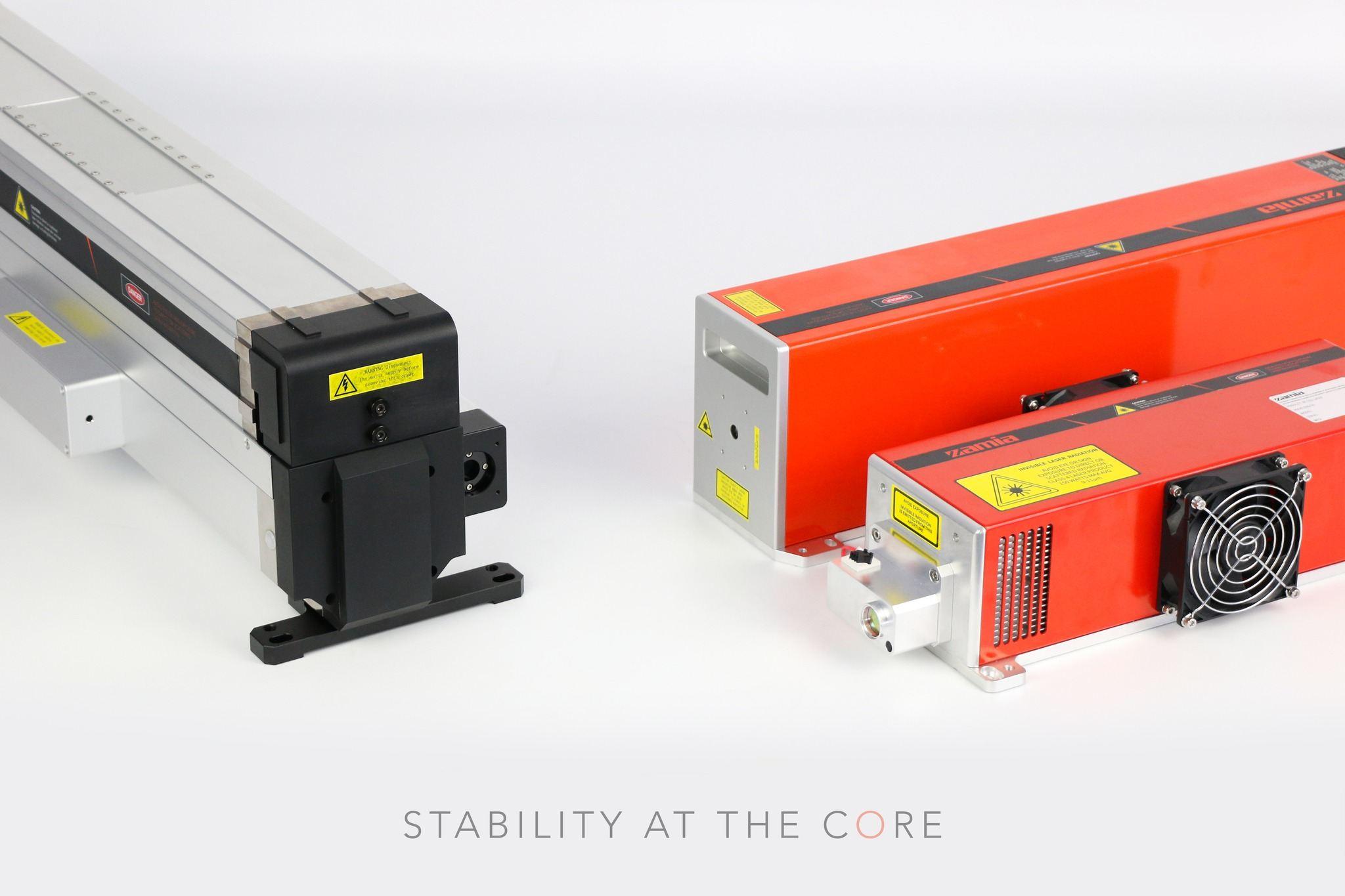
ZAMIA Q Series, F Series, and N Series RF CO2 lasers
However, this does not mean that all RF CO2 lasers necessarily have high beam quality. Final performance still depends on resonator design, discharge uniformity, thermal management, beam shaping, and factory testing standards. For cutting, marking, and drilling applications, customers usually care more about long-term consistency:
· Whether the parameters established during initial setup can be reused reliably in later production;
· Whether the kerf changes noticeably between cold-start and warmed-up operation;
· Whether the beam mode drifts after long-term operation;
· Whether small-character marking, QR codes, and micro-hole arrays remain consistent;
· Whether process parameters can be easily reused when lasers from different batches are installed on machines.
For equipment manufacturers and end users, these long-term behaviors are usually more meaningful than the maximum power measured in a single test. Different manufacturers use different cavity designs, gas formulations, thermal management methods, and optical beam-shaping capabilities. Therefore, beam quality should not be judged only by the excitation method. The final evaluation should be based on measured M²ₓ / M²ᵧ values, beam profile, power stability, and actual processing samples.
10. Frequently Asked Questions
Q: What is M² in a CO2 laser?
A: M² is a parameter used to evaluate laser beam quality. It can be understood as the ratio between the BPP of the actual beam and that of an ideal Gaussian beam. The closer M² is to 1, the closer the beam is to an ideal Gaussian beam. In most cases, this means the beam can be focused into a smaller spot with more concentrated energy. M² is typically measured according to ISO 11146.
Q: Why do CO2 lasers with the same power produce different processing results?
A: Because processing performance depends not only on rated power, but also on beam quality, beam mode, actual output stability, laser focus lens quality, optical alignment, and process parameters such as speed, assist gas, and focus position. Even when the rated output power is similar, the spot size, energy distribution, and stability at the substrate surface may differ significantly.
Q: Does M² affect kerf width?
A: Yes. Under comparable optical and process conditions, a lower M² generally produces a smaller focused spot, which makes it easier to achieve a narrower kerf. However, the final kerf width also depends on material response, focus position, cutting speed, assist gas, and power density.
Q: Why are RF CO2 lasers commonly used for precision processing?
A: RF CO2 lasers usually offer good discharge stability, fast modulation response, and strong long-term consistency, making them common in film cutting, micro-hole processing, QR code marking, small-character marking, and high-precision marking. However, the actual beam quality still depends on the manufacturer’s cavity design, thermal management, and optical beam-shaping capability. Measured M²ₓ / M²ᵧ values, beam profile, and processing samples should be used as references.
Q: Is a lower M² always better when selecting a CO2 laser?
A: Not always. A lower and more symmetric M² is usually beneficial for film cutting, micro-hole processing, small-character marking, QR code marking, and high-precision contour cutting. For general engraving or lower-precision cutting, rated power, power stability, cost, maintenance, system integration, and production requirements may be more important.
11. Conclusion
When selecting a CO2 laser, rated power alone does not fully describe processing capability. It indicates the laser’s specified output level, while M² shows whether that energy can be effectively focused into a small and concentrated focal area. For precision cutting, micro-hole processing, and high-resolution marking, M²ₓ / M²ᵧ, beam profile, power stability, and lifecycle consistency should all be evaluated together.
For equipment manufacturers and end users, the more useful RF CO2 laser is not simply the one with higher rated power. It is the one that can maintain stable, concentrated, and controllable beam output on real substrates, at real processing speeds, and under continuous production conditions. Before final selection, request the manufacturer’s beam profile, M² measurement data, and material test samples to reduce setup cost and production risk.
Formula and Standard Notes
The formulas in this article, including focused spot diameter, equivalent average power density, and Rayleigh length, are based on standard approximations of Gaussian beam propagation with M² correction. They assume that the incident beam is well collimated and do not include lens aberration, contamination, thermal lensing, or alignment errors.
M² measurement usually follows ISO 11146. The values and trends in this article are used to explain the underlying principles. Actual evaluation should be based on the manufacturer’s measured reports and material processing samples.
Reference standard: ISO 11146, which covers methods for measuring laser beam widths, divergence angles, and beam propagation factors. The definitions of BPP and M² in this article follow common laser optics conventions.
Common Parameters Used in This Article
|
Parameter |
Meaning |
|
M² |
Beam quality factor. The closer the value is to 1, the better the focusing capability usually is. However, selection should still consider power, beam mode, material, and processing objectives. |
|
M²ₓ / M²ᵧ |
Beam quality factors in the X and Y directions. Differences between the two directions affect spot symmetry and processing consistency. |
|
BPP |
Beam Parameter Product = beam waist radius × far-field divergence half-angle. It is usually expressed in mm·mrad. |
|
BPPmin |
Minimum beam parameter product of an ideal Gaussian beam, where BPPmin = λ / π. |
|
w₀ |
Beam waist radius. |
|
w_f |
Focused spot radius, where w_f = d_f / 2. |
|
θ |
Far-field divergence half-angle. |
|
d_f |
Focused spot diameter. In this article, it is understood approximately as the 1/e² spot diameter. |
|
z_R |
Rayleigh length. Depth of focus, or DOF, can be approximated as 2 × z_R. |
|
λ / f / D |
Wavelength / focal length of the laser focus lens / effective beam diameter incident on the laser focus lens. D is not the physical clear aperture of the lens. |
|
I_avg / HAZ |
Equivalent average power density / heat-affected zone. |