

In recent years, consumer-grade laser equipment has attracted growing attention as a distinct segment of the laser industry. As desktop laser engravers, consumer laser cutters, and personal fabrication tools continue to expand, related companies have become more active in financing rounds, listing plans, and industrial partnerships.
Recent market moves illustrate this trend. xTool has submitted a listing application to the Hong Kong Stock Exchange, Creality has been listed in Hong Kong, Aliencell Yuanyin Technology has completed an angel round, and Ruiling Intelligent has secured Pre-A financing. At the same time, upstream laser manufacturers such as JPT and Raycus Laser are stepping up their involvement in consumer laser applications.
The segment is gradually moving beyond early hobbyist use and interest-driven consumption, and is expanding into personal creation, micro-entrepreneurship, home studios, and flexible low-volume production.
Capital Interest Rises as End-User Demand Expands
The rising popularity of consumer-grade laser equipment is closely linked to changing end-user demand.
On the demand side, the global maker movement, personalized customization, micro-businesses, and home studio production continue to grow. Laser engravers and laser cutters can process wood, acrylic, leather, paper, and other materials, making them suitable for small-batch, multi-category production. From the perspective of processed materials, non-metal materials remain one of the main application areas for consumer-grade laser equipment.
CO2 lasers have a proven application base in wood, acrylic, leather, and other non-metal processing fields. As consumer laser systems become more professional and versatile, the practical value of CO2 laser technology in non-metal processing is expected to become more evident.
On the software side, AI design tools, online creative asset platforms, and software ecosystems are lowering the barrier to adoption for non-professional users. Design and processing workflows that once required more technical experience are increasingly being simplified through user-friendly software, parameter libraries, and template-based tools.
As a result, consumer-grade laser equipment is expanding from hobby-based personal creation to customized gifts, small-batch processing, home studios, and micro-business applications. For investors and companies across the value chain, this shift suggests a broader addressable market and greater commercial upside.
According to public information and data compiled by the China Commercial Industry Research Institute, the global consumer-grade laser engraver market expanded overall from 2020 to 2025 and is forecast to continue growing in 2026. The market size was approximately USD 1.2 billion in 2025 and is projected to reach USD 1.5 billion in 2026.
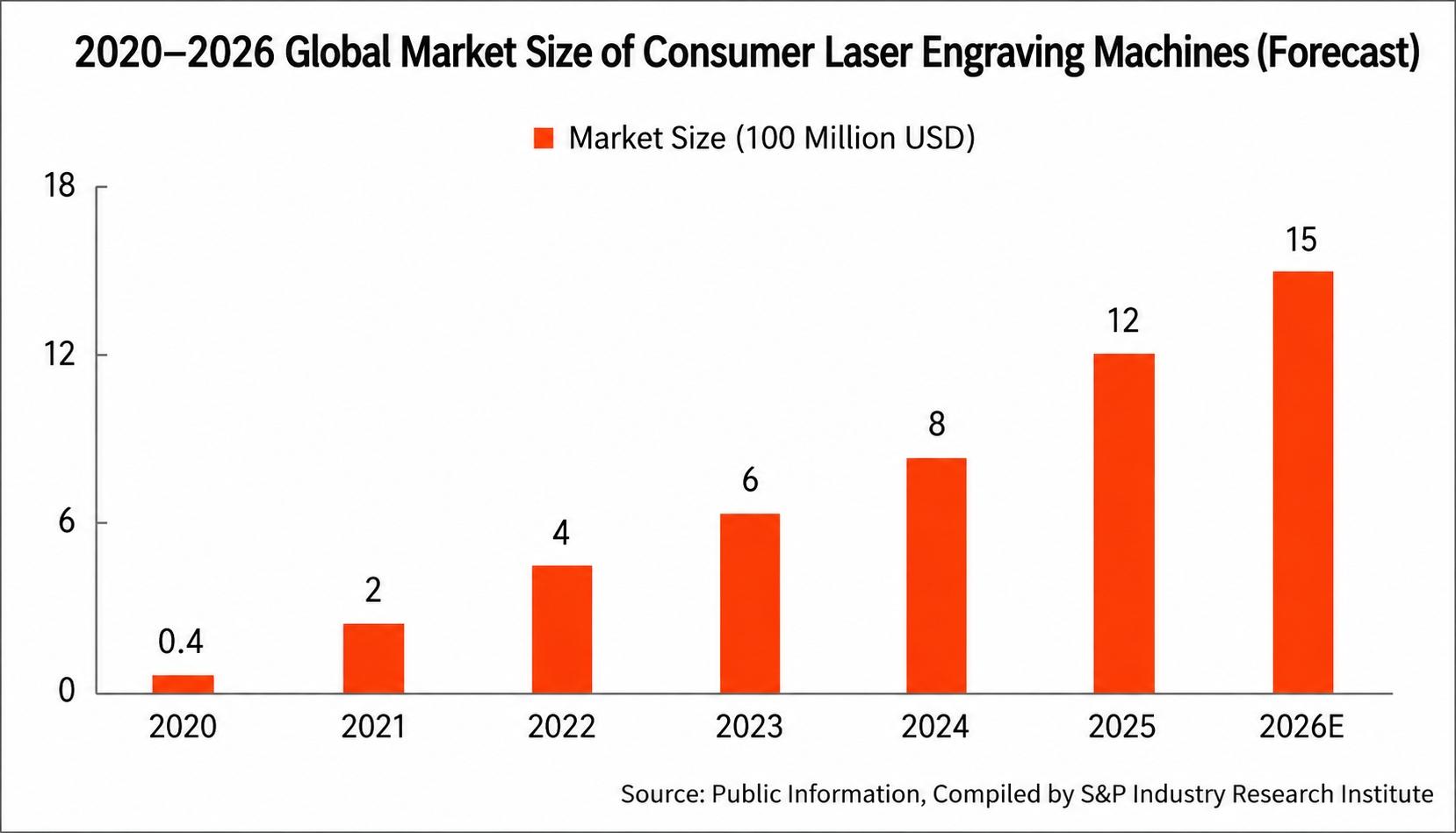
Global consumer-grade laser engraver market size trend, 2020-2026E. Source: public information compiled by China Commercial Industry Research Institute.
Financing and Listing Activity Accelerates Among Consumer-Grade Laser Brands
Since the beginning of 2026, several consumer-grade laser engraver companies have moved toward public listings, while some younger companies have secured sizable financing within a relatively short period of time.
In January 2026, xTool officially submitted its listing application to the Hong Kong Stock Exchange. If the listing is completed as planned, xTool could become the first publicly listed company focused on consumer-grade laser engravers in Hong Kong, and potentially one of the first of its kind in global capital markets. Before the application, xTool had completed approximately USD 200 million in Pre-IPO financing, with investors including Tencent, Granite Asia, Cathay Capital, and GRC.
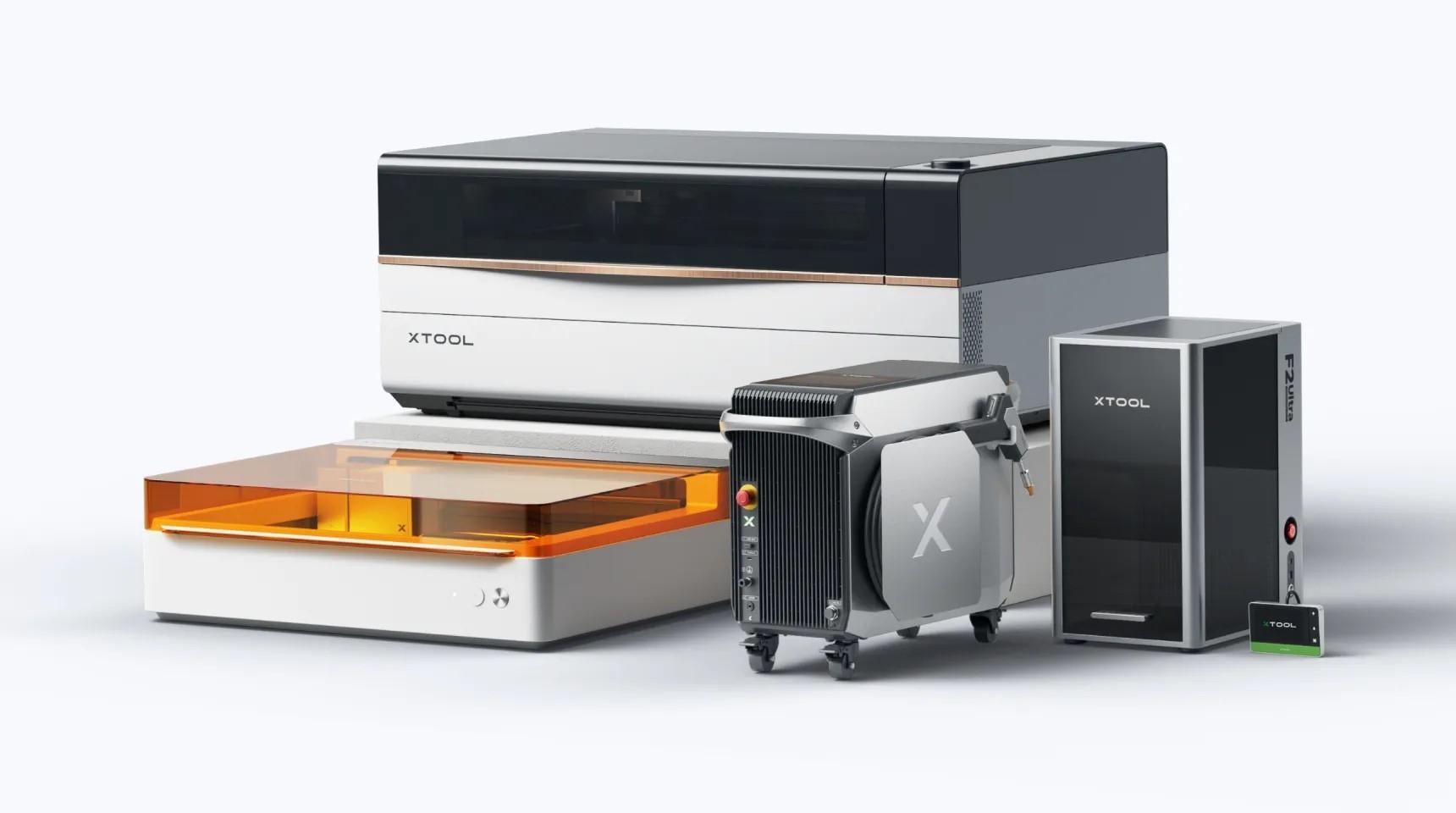
Selected xTool consumer laser equipment (Source: Internet, infringement can be deleted)
Creality was listed on the Hong Kong Stock Exchange in May 2026. The company was originally known for consumer 3D printing products, but it has also expanded into laser engravers, 3D scanners, and other digital manufacturing tools. Its entry into the capital market further indicates that consumer digital fabrication equipment is developing into a more complete product ecosystem.
Aliencell Yuanyin Technology announced in May 2026 that it had completed tens of millions of RMB in angel financing. The funds will be used for technology development, product mass production, team building, and global market expansion.
Ruiling Intelligent has also completed Pre-A financing, with the funds mainly intended for R&D innovation, capacity expansion, and market development. The concentrated financing and listing activity among multiple companies suggests that the consumer-grade laser equipment segment is becoming more crowded and competitive.
Upstream Laser Manufacturers Move Deeper Into the Segment
The development of consumer-grade laser equipment is also drawing upstream laser manufacturers deeper into the segment.
For equipment manufacturers, the laser source is one of the important components affecting processing performance, equipment cost, and product stability. As consumer laser systems move toward higher precision, smaller form factors, and compatibility with more materials, upstream suppliers need to provide laser source products that are more compact, stable, and easier to integrate.
From the perspective of technology routes, the types of laser sources used in consumer-grade equipment are becoming increasingly diverse. Due to their proven application base and strong adaptability in wooden crafts, acrylic products, leather processing, packaging prototyping, and other non-metal processing fields, CO2 lasers remain one of the laser source options attracting attention from consumer-grade laser equipment manufacturers.
In the consumer-grade CO2 laser field, SPT Laser has long focused on two major product lines: RF CO2 lasers and CO2 laser tubes. With more than 10 years of R&D and application experience, the company has built a mature technical foundation in product stability and consistency. Within China’s domestic supply chain for consumer-grade CO2 laser equipment, SPT Laser is a major laser source supplier, with a reported market share of more than 65%. Its laser products are widely integrated into desktop laser engraving and cutting systems, with a strong supporting presence in non-metal processing applications such as wood, acrylic, and leather, and stable supply relationships across several segmented markets.
In the fiber laser field, JPT has begun supplying MOPA pulsed fiber laser sources for the consumer-grade laser engraver market in recent years and has received batch orders from customers. The company is also promoting the application of pulsed fiber laser sources in consumer-grade laser engravers and conducting product validation and solution matching with downstream customers.
It is also worth noting that after Creality was listed, JPT and Creality Ecosystem announced the establishment of a joint laboratory focused on consumer-grade precision laser technology. This indicates that upstream laser manufacturers are becoming more deeply involved in the technical development of consumer end-use equipment.
Raycus Laser is also expanding into the consumer laser market. Its product portfolio includes pulsed Mini series laser sources, MOPA series laser sources, air-cooled UV laser sources, blue laser sources, and air-cooled continuous-wave laser sources, mainly targeting DIY users, small business owners, and desktop equipment applications. In addition, companies such as Guangzhi Technology and Han's Photonics are also paying attention to consumer laser application opportunities.
Competition Intensifies as the Segment Begins to Differentiate
Behind the enthusiasm of capital, the competitive landscape is becoming more complex.
From the current market structure, brand tiers in the consumer-grade laser engraver segment have already begun to diverge. Leading brands are building barriers through brand recognition, user communities, and supply chain capabilities, while many small and medium-sized players still rely mainly on price-based competition. It is reported that over the past year, several core executives from leading laser cutting companies have left established companies to start new ventures in this field, further accelerating talent mobility and fragmenting technical know-how across the market.
For companies currently seeking financing or IPOs, the ability to build sustainable differentiation during the market expansion period will directly affect their position in the next stage of competition.
From an industry trend perspective, differentiation is not limited to end-user-facing capabilities such as brand strength and software ecosystem. It is also extending to the integration and control of upstream supply chains. In this context, for laser equipment that depends heavily on core laser source performance, the stability of the upstream laser supply chain and the consistency of laser source products are becoming important factors for equipment manufacturers when evaluating partners.
Market Outlook
Consumer-grade laser equipment is a market segment with growth potential, but it is not a low-barrier market.
On the demand side, the markets for personalized customization, small-scale processing, and digital creation continue to expand. On the supply side, laser sources, control systems, software, and complete machine manufacturing capabilities are also becoming more mature. However, as more players enter the market, competition is likely to intensify further.
In this context, whether equipment brands can continue to deliver stable, easy-to-use, and safe products will be a decisive factor in their long-term competitiveness. For upstream laser manufacturers, as consumer laser systems continue to upgrade toward easier operation and more professional use, demand for compact, lightweight, and highly stable laser source products is expected to become more prominent.
In non-metal processing applications in particular, CO2 lasers still have considerable room for development in desktop laser cutting, engraving, and creative manufacturing, supported by a mature application base and stable market demand.
Overall, the capital activity of xTool, Creality, Aliencell Yuanyin Technology, and Ruiling Intelligent, together with the market expansion of laser manufacturers such as JPT and Raycus Laser, shows that consumer-grade laser equipment has become a segment worth watching within the laser industry value chain. However, strong market interest does not necessarily translate into sustained growth. Companies that remain competitive over the long term will still need to rely on product quality, technology, supply chain capability, and service strength.