

In laser cutting, engraving and marking, laser focus spot size is a key parameter for many users. In this article, “focus spot size” refers to the theoretical focused spot diameter calculated from laser wavelength, M² beam quality factor, focal length and incident beam diameter.
The focused spot diameter directly affects laser energy concentration and can influence kerf width, engraving line definition, marking details and other processing outcomes.
Generally, a smaller focused spot delivers higher energy density, making it better suited to precision processing. Conversely, a larger spot spreads energy over a broader area, which may change the final processing result.
To help users quickly estimate laser focus spot size under different optical parameters, SPT Laser offers an online Focused Spot Diameter Calculator. By entering several key parameters, users can obtain reference results in seconds.
→ Use the Laser Focus Spot Size Calculator ←
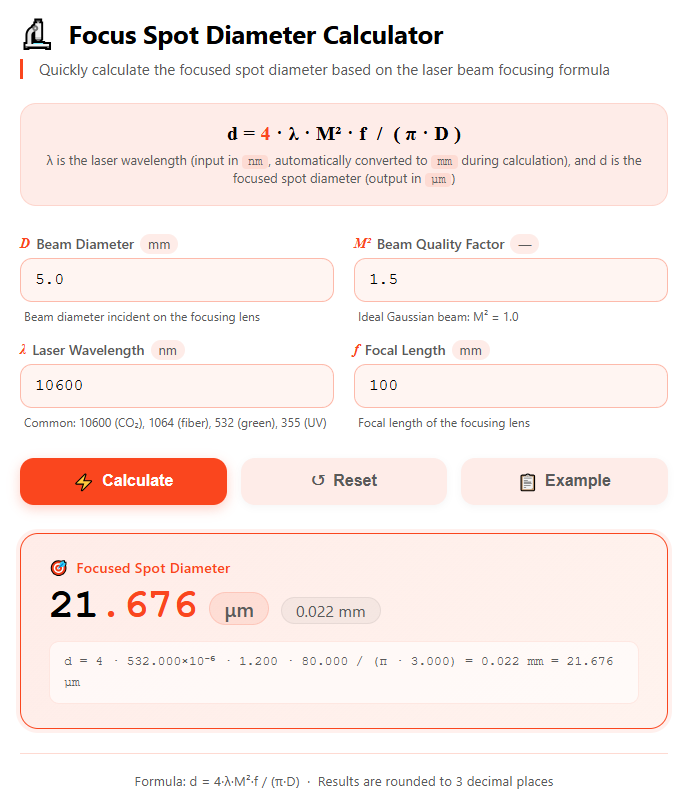
Laser Focus Spot Size Calculator Page

The calculation formula is:

Where:
d: Focused spot diameter.
λ: Laser wavelength.
M²: Beam quality factor.
f: Focal length of the focusing lens.
D: Incident beam diameter before the focusing lens.
The formula shows that, with all other parameters unchanged, a shorter focal length f produces a smaller theoretical spot size; an M² value closer to 1 indicates better beam quality and tighter focusing capability; and a larger incident beam diameter D can also reduce the theoretical spot size.

For example, consider a CO2 laser system with the following parameters:
Laser wavelength λ = 10600 nm = 0.0106 mm
Incident beam diameter D = 5 mm
Beam quality factor M² = 1.2
Focal length of the laser focusing lens f = 100 mm
Substituting these values into the formula:

The calculated result is d ≈ 0.324 mm, or approximately 324 μm. With these optical parameters, the theoretical focused spot diameter is approximately 324 μm.
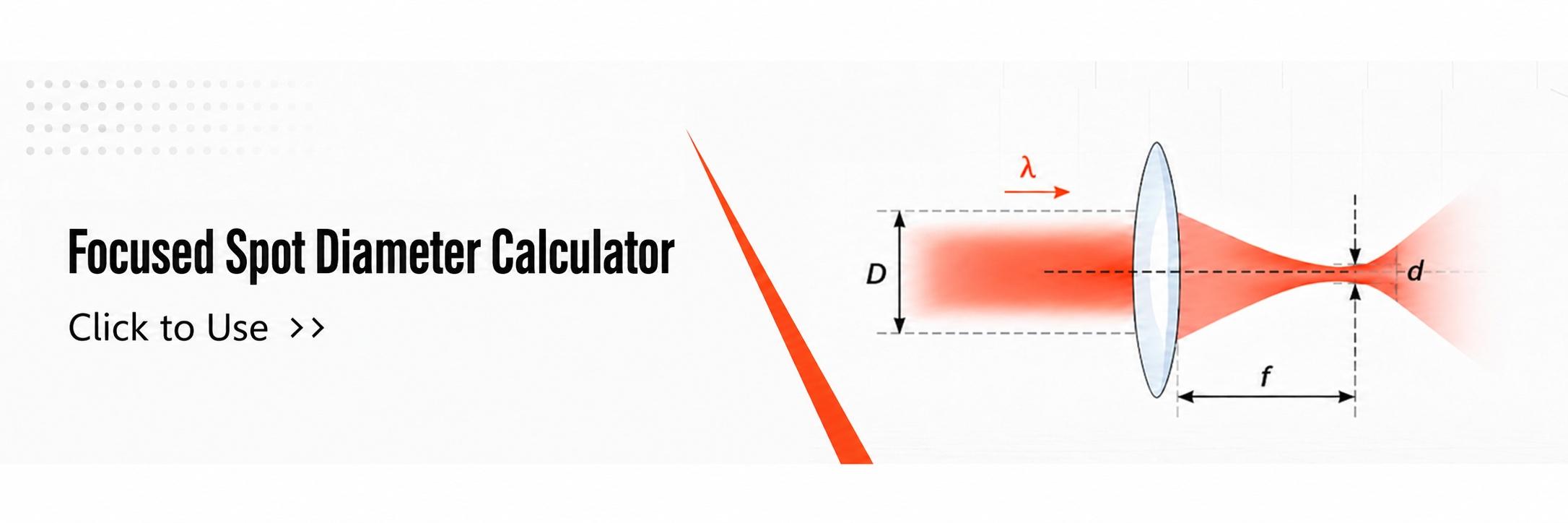
The Focused Spot Diameter Calculator enables fast estimation of theoretical spot sizes for different parameter configurations. In practical industrial use, however, the calculated theoretical spot diameter should be used only as a reference. The final cutting, engraving and marking results are also affected by material type, laser power, processing speed, focal position, and the overall optical condition and alignment of the laser equipment.